Light Without the Swarm: How Smart Solar Lighting Choices Keep Insects at Bay
There is a familiar ritual that plays out in backyards across America every summer evening: a homeowner switches on the patio lights, sets out a cold drink, and within minutes finds themselves swatting at a cloud of moths, gnats, and mosquitoes drawn to the glow. The instinctive response is often to reach for a bug zapper or a can of chemical repellent. However, a more elegant solution exists at the design level itself — one that begins with the solar lights you choose and where you place them.
Understanding why insects are attracted to light in the first place is the foundation of any effective strategy. Most flying insects navigate by orienting themselves relative to natural light sources such as the moon and stars. Artificial light disrupts this system, causing insects to spiral inward toward the source. Critically, not all wavelengths of light are equally disorienting. Ultraviolet and blue-spectrum light — the kind emitted in abundance by traditional incandescent bulbs and many standard LED fixtures — are highly visible to insects, whose eyes are particularly sensitive to shorter wavelengths. This is precisely why bug zappers work: they exploit that same attraction.
The Color Temperature Advantage in Solar LED Technology
Modern solar lighting systems offer homeowners a meaningful degree of control over the color temperature of their fixtures. Color temperature, measured in Kelvin (K), describes the warmth or coolness of a light source. Fixtures rated at 2700K to 3000K emit a warm, amber-toned glow that falls outside the peak sensitivity range of most common pest insects. By contrast, fixtures rated above 5000K produce a cool, bluish-white light that is significantly more attractive to moths, midges, and other flying insects.
For outdoor entertaining areas, pathway lighting, and garden accents, selecting solar fixtures that output warm white light in the 2700K to 3000K range is one of the single most effective passive insect-reduction strategies available. Many quality solar lights marketed for residential use now specify color temperature on their packaging or product listings. Homeowners should treat this specification as a primary selection criterion, not an afterthought.
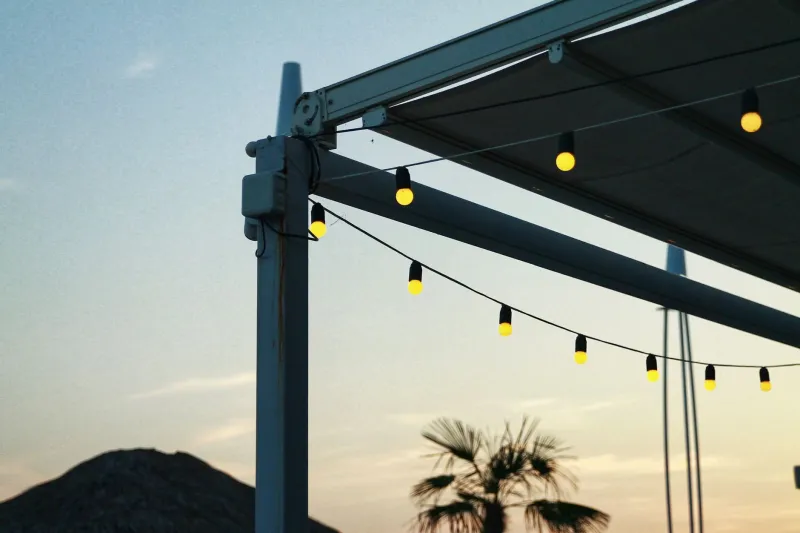
Amber and yellow-tinted solar fixtures take this principle even further. Historically dismissed as aesthetically limited, amber LED technology has advanced considerably. Contemporary amber solar lanterns and stake lights can anchor a cohesive design scheme while delivering a spectrum that most insects simply cannot detect as effectively. For porches, pergolas, and dining patios where the human-insect conflict is most intense, amber-spectrum solar fixtures represent a practical and visually appealing solution.
Strategic Placement: Drawing Insects Away from Living Spaces
Color temperature addresses part of the problem, but placement addresses the other. Even a warm-spectrum solar fixture, if positioned directly above a seating area, will still attract some insects into the immediate vicinity. A more sophisticated approach uses lighting placement to redirect insect activity away from where people gather.
This technique, sometimes called perimeter displacement, involves installing brighter or cooler-spectrum solar lights at the edges of a property — along fence lines, at the far corners of a yard, or near tree lines — while keeping the central gathering area illuminated with dimmer, warmer fixtures. Insects drawn to light will tend to congregate at the brighter perimeter sources rather than at the more subdued interior lights. The result is an outdoor space that remains functional and attractive while keeping the majority of insect activity at a comfortable distance.
Solar-powered path lights positioned along walkways and garden borders serve double duty in this framework. They guide foot traffic and define the landscape while simultaneously acting as minor insect attractants that are physically separated from seating and dining areas. Because these fixtures are typically lower to the ground and lower in lumen output, they cause minimal disruption to the overall insect-displacement strategy.
Integrated Fixtures and Motion Sensitivity
Another underutilized tool is the motion-activated solar light. Fixtures that illuminate only when triggered by movement spend the majority of their operating hours in a low-output or completely dark state, dramatically reducing the cumulative hours of insect-attracting light emitted over the course of an evening. For areas such as side yards, garages, and less-frequented corners of a property, motion-sensitive solar security lights offer both practical illumination and a significantly reduced insect footprint compared to lights that burn continuously from dusk to dawn.
Some advanced solar fixtures now incorporate dual-mode operation: a dim, warm ambient mode that runs throughout the night and a brighter, cooler activation mode triggered by motion. For homeowners seeking a balance between continuous low-level ambiance and on-demand security illumination, this technology represents a thoughtful compromise that also minimizes sustained insect attraction.
What Solar Lighting Cannot Do Alone
It would be misleading to suggest that lighting design alone will eliminate insects from an outdoor space. Mosquitoes, for instance, are not primarily light-attracted — they locate hosts through carbon dioxide, body heat, and chemical cues. No lighting strategy will meaningfully reduce mosquito pressure on its own. However, the broader insect reduction achieved through smart solar lighting does reduce the overall density of insects present, which in turn reduces the food sources that attract mosquitoes' predators and competitors, creating a less hospitable overall environment.
For comprehensive pest management, solar lighting strategy pairs well with physical measures such as eliminating standing water, maintaining dense plantings of naturally repellent species like lavender and citronella grass, and using non-chemical personal repellents during peak activity hours. These approaches are complementary rather than competing, and none of them require compromising the visual integrity of an outdoor space.
Choosing Fixtures for Both Beauty and Practicality
The solar lighting market has matured significantly in recent years, and homeowners no longer face a meaningful trade-off between aesthetically compelling fixtures and technically sound ones. Warm-spectrum, high-quality solar lanterns, pendant-style fixtures, and stake lights are widely available at price points accessible to most residential budgets. When evaluating options, look for fixtures that specify a color temperature of 3000K or below, provide an IP65 or higher weather resistance rating for durability, and include adjustable brightness or motion-sensitivity settings where the application warrants it.
The goal is not to create a sterile, insect-free environment — a healthy yard ecology depends on a functional insect population. The goal is to reclaim your outdoor living space from the most disruptive guests, using the same clean solar energy that powers your lights to do so intelligently, sustainably, and beautifully.