Zones of Light: Designing a Solar-Powered Outdoor Layout That Gives Every Space Its Own Identity
Most homeowners approach outdoor solar lighting the same way they approach purchasing furniture: one piece at a time, driven by immediate need, with little reference to a larger compositional plan. A path light here, a floodlight there, a decorative lantern near the front steps — each purchase makes local sense, but the cumulative result is often a lighting environment that feels arbitrary rather than intentional. The property is technically illuminated, but it does not read as a designed space.
The alternative — treating solar lighting as an architectural and landscape design element from the outset — yields a fundamentally different result. When light is used deliberately to define zones, establish visual hierarchy, and guide movement through a property, the outdoor environment becomes as organized and purposeful as the interior of the home. And because solar technology has advanced to a point where high-quality, aesthetically refined fixtures are widely available, achieving this level of outdoor design no longer requires a professional landscape architect or a significant electrical infrastructure investment.
Thinking in Zones Before Thinking in Fixtures
The first step in creating a cohesive solar lighting plan is to map the functional zones of the property before selecting a single fixture. Most residential properties contain four to six distinct outdoor zones: the entry approach and front facade, the driveway and parking area, transition pathways between zones, the primary outdoor living space (deck, patio, or terrace), the garden or landscape areas, and the perimeter boundary. Each of these zones has a different functional purpose, a different ambient light requirement, and a different aesthetic register.
Drawing a simple overhead sketch of the property — even a rough one — and labeling each zone according to its primary function is a surprisingly clarifying exercise. It immediately reveals which areas are currently over-lit, which are neglected, and where the transitions between zones are undefined. It also surfaces a question that most homeowners never think to ask: what is the intended relationship between adjacent zones? Should the deck feel like a warm, intimate extension of the interior, while the driveway is treated as a more utilitarian, brightly lit approach? Or should the entire property read as a unified design statement, with a consistent visual language applied across all zones at varying intensities?
Answering these questions before purchasing a single fixture saves considerable time and expense, and it produces a far more coherent result.
The Deck and Patio: Warmth as a Design Intention
Outdoor living spaces — decks, patios, pergola-covered terraces — are the zones where solar lighting has the greatest potential to transform the character of a property. These are the spaces where people gather, dine, and relax, and they benefit from layered lighting that creates depth and warmth rather than uniform brightness.
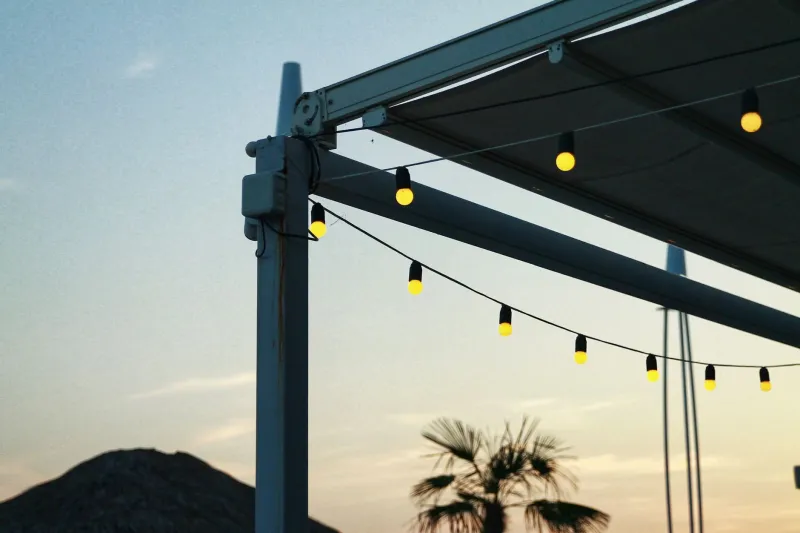
For deck environments, a combination of low-mounted post cap lights, string-light configurations supported by solar-powered drivers, and subtle step lighting creates the kind of ambient layering that makes an outdoor space feel genuinely inviting after dark. The key is to keep color temperatures warm — in the 2700K to 3000K range — and to avoid any single fixture that dominates the space with excessive output. The goal is an even wash of warm light that feels continuous rather than spotty.
Integrating solar-powered recessed deck lights into the deck surface itself is an increasingly popular option that eliminates the visual clutter of stake lights while providing consistent ground-level illumination. These fixtures are particularly effective at defining the perimeter of the deck zone, creating a visual boundary that reads as intentional from across the yard.
Pathways as Connective Tissue
If zones are the rooms of an outdoor property, pathways are the hallways. Solar path lighting serves a navigational function, but in a well-designed landscape, it does considerably more than that. Thoughtfully positioned pathway fixtures create visual rhythm — a sequence of repeated light points that draws the eye and the foot through the space in a deliberate direction.
The spacing of pathway lights has a significant effect on this rhythm. Fixtures placed too close together create a runway effect that feels institutional rather than residential. Fixtures spaced too far apart leave dark gaps that interrupt the visual flow. For most residential pathways, a spacing of six to eight feet between fixtures strikes the right balance, providing sufficient illumination for safe passage while creating a graceful, measured cadence.
Path lights also serve as zone dividers. A row of solar stake lights along the edge of a garden bed, for instance, simultaneously illuminates the pathway and defines the boundary between the lawn and the planting zone. This dual function — wayfinding and spatial definition — makes pathway lighting one of the highest-value investments in a comprehensive solar lighting plan.
Driveways and Entry Approaches: Clarity and First Impressions
The driveway and front entry are the zones that shape a property's first impression, and solar lighting here should project clarity and confidence rather than decorative warmth. Bollard-style solar lights along the driveway edge provide a clean, architectural line that reads well both at night and during the day when the fixtures are visible as design elements in their own right.
For the front entry itself, a pair of well-proportioned wall-mounted solar lanterns flanking the door creates the kind of symmetrical emphasis that anchors the facade and signals arrival. These fixtures should be selected to complement the architectural style of the home — a craftsman-style lantern for a bungalow, a sleek rectangular fixture for a contemporary build — because they will be among the most visible elements of the property's exterior during daylight hours.
Solar-powered address lighting, an often-overlooked category, adds both practical utility and a polished finishing detail. Illuminating a house number clearly from the street improves emergency response access and contributes to the overall sense that the property has been thoughtfully considered.
Perimeter and Garden Zones: Depth and Drama
The outer zones of a property — garden beds, tree lines, fence boundaries — offer the greatest opportunity for dramatic solar lighting effects. Uplighting a mature tree with a solar-powered ground spike creates a striking visual anchor that adds depth to the nighttime landscape and draws the eye outward, making the property feel larger. Wash lighting along a fence or garden wall creates texture and shadow play that transforms a flat surface into a dynamic visual element.
These perimeter lighting choices also perform the practical function of defining the property's extent after dark, a subtle but effective contribution to the overall sense of a well-organized, intentionally designed outdoor environment.
The Value of Coherence
Real estate professionals consistently cite outdoor lighting as one of the landscape improvements with the strongest return on investment at the point of sale. Properties with cohesive, well-executed outdoor lighting systems photograph better, show better at evening viewings, and communicate a level of care and intentionality that resonates with buyers.
For homeowners who intend to remain in their homes for years to come, the return is experienced differently — as daily quality of life. A property organized by light into distinct, purposeful zones is simply more enjoyable to inhabit. The deck feels like a destination. The pathway feels like a journey. The entry feels like a welcome. Solar energy makes all of this possible without grid dependency, without trenching, and without the kind of installation complexity that has historically kept sophisticated outdoor lighting design out of reach for most homeowners.