Too Close for Comfort: How Neighboring Solar Lights Undermine Each Other and How to Fix It
When homeowners invest in a solar lighting system, they typically focus on individual fixtures—output ratings, battery capacity, sensor sensitivity. What rarely enters the conversation is how those fixtures interact with one another once they are all switched on. The uncomfortable truth is that solar lights placed too close together, or clustered without a deliberate spatial strategy, can actively work against each other. The result is a system that appears functional on the surface but is operating well below its potential.
This guide examines the specific mechanisms behind solar light interference, offers practical spacing benchmarks for common fixture categories, and provides placement strategies that allow every light on your property to perform at its designed capacity.
Understanding the Problem: Three Distinct Forms of Interference
Not all interference is the same. Before prescribing solutions, it is worth distinguishing between the three primary ways that neighboring solar lights conflict with one another.
Light Bleed and Sensor Confusion
Most solar-powered security and pathway lights rely on photosensors to determine when ambient light has dropped below a threshold—typically triggering activation at dusk and deactivation at dawn. When two lights are positioned close enough that one fixture's output reaches the photosensor of another, the receiving light may interpret that artificial glow as residual daylight. This causes delayed activation, premature shutoff, or erratic cycling throughout the night. In practical terms, one well-placed light can prevent a neighboring fixture from ever fully switching on.
Competing Passive Infrared (PIR) Sensors
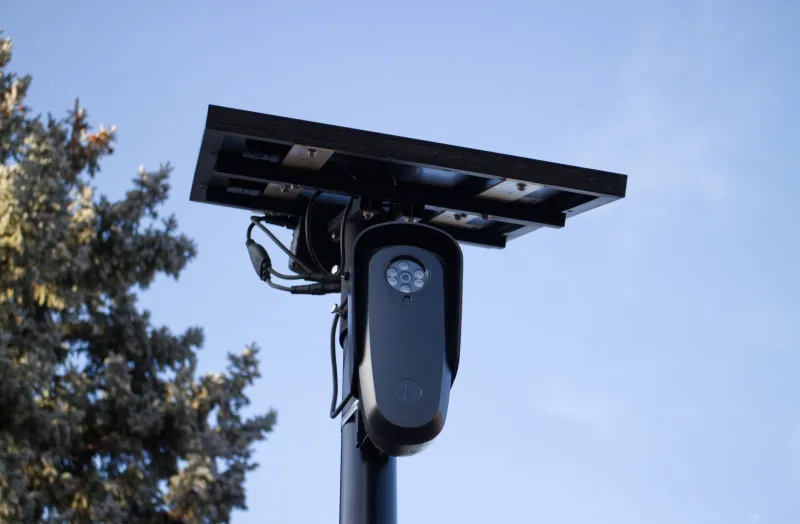
Motion-activated solar lights use passive infrared sensors to detect heat signatures moving through their detection zone. A single PIR sensor covers a defined arc—commonly between 90 and 180 degrees—at a specified range, often between 15 and 40 feet depending on the model. When two motion-activated lights face each other or overlap substantially in their detection fields, each light's activation can trigger the other. This creates a feedback loop where both fixtures remain illuminated far longer than intended, draining battery reserves and reducing the meaningful security value of motion detection as a behavioral deterrent.
Reflective Interference and Glare Overlap
Hard surfaces—concrete driveways, white siding, glass windows, and even certain decorative stones—reflect light in ways that amplify the bleed problem. A fixture mounted near a reflective surface may cast secondary illumination across a wide area, inadvertently affecting neighboring lights' sensors and detection zones. This is particularly common in compact urban yards and along driveways lined with pale pavers.
The Physics Behind It: Why Proximity Matters More Than Wattage
Artificial light diminishes in intensity according to the inverse square law: doubling the distance from a source reduces its intensity to one-quarter of the original value. This principle has a direct implication for solar light placement. A 200-lumen fixture that appears modest in isolation can still deliver enough light at 10 feet to confuse a neighboring photosensor calibrated to activate at low ambient levels.
Infrared energy follows similar physical rules. PIR sensors do not read visible light—they read thermal contrast. A warm body moving through a cool background is the intended trigger. However, when two PIR-equipped fixtures are aimed toward each other, the heat signature of one fixture's illuminated surface can register as a detectable thermal event for the other, particularly during cooler nights when contrast is highest.
This is not a flaw in any individual product. It is a predictable consequence of deploying multiple precision instruments in close proximity without accounting for their operational overlap.
Spacing Guidelines by Fixture Type
The following benchmarks are general recommendations based on common fixture categories available in the US residential market. Individual specifications vary by manufacturer, so always consult your product documentation for exact sensor range and detection angle data.
Pathway and Accent Lights These low-output fixtures (typically 10–50 lumens) present minimal photosensor interference risk when spaced at least 6 to 8 feet apart along a walkway. Closer spacing is aesthetically common but risks creating a runway effect that overwhelms the photosensors of every other fixture in the line.
Wall-Mounted Security Lights Fixtures in the 300–1,000 lumen range with integrated PIR sensors should be spaced a minimum of 20 feet apart when mounted on the same wall plane. When mounted on adjacent walls meeting at a corner, orient detection zones outward rather than toward each other to eliminate feedback activation.
Floodlights and Area Lights High-output solar floodlights (1,000 lumens and above) require the most deliberate separation. On a standard residential property, no two floodlights should share overlapping detection zones unless the overlap is intentional for coverage redundancy—and even then, photosensor shields should be considered to prevent cross-activation.
Post-Top and Decorative Lanterns These omnidirectional fixtures scatter light in all directions, making them particularly prone to photosensor interference when clustered. A minimum spacing of 10 feet is advisable, with 15 feet preferred in open areas without natural barriers.
Strategic Placement Solutions
Use Natural Barriers as Buffers Hedges, fencing, garden walls, and even dense ornamental plantings can serve as effective light breaks between neighboring fixtures. Positioning a pathway light on the far side of a low shrub from a motion-activated wall light, for example, dramatically reduces the likelihood of photosensor contamination.
Orient Detection Zones Deliberately When mounting motion-activated lights, visualize the PIR detection arc as a cone projecting outward from the fixture. Two adjacent fixtures should have their cones aimed in complementary rather than opposing directions—one covering the driveway approach, the other covering the side yard, for instance. This maximizes coverage while eliminating the conditions for feedback loops.
Install Photosensor Shields Many security light manufacturers offer optional photosensor shields or visors as accessories. These inexpensive additions block ambient light from reaching the photosensor except from the intended overhead direction, effectively neutralizing the influence of neighboring fixtures. For homeowners with established installations that cannot be easily relocated, this is often the most practical first intervention.
Stagger Heights Across Zones Mounting fixtures at varying heights—ground-level accent lights, mid-height wall mounts, and elevated floodlights—naturally reduces the likelihood that any two fixtures will share the same optical plane. A low-mounted pathway light is far less likely to interfere with a floodlight mounted eight feet up on a garage wall than it would with another ground-level fixture positioned three feet away.
Audit at Night The most reliable diagnostic tool available to any homeowner is a simple nighttime walkthrough. Observe each fixture individually: Does it activate at the expected time? Does it respond to motion within its rated range? Does it shut off appropriately? Anomalous behavior—delayed activation, unexpected cycling, or failure to respond to motion—is often the first visible symptom of interference from a neighboring light. Identifying the problem fixture and adjusting its position or orientation is almost always sufficient to restore normal operation.
A System Designed to Work Together
Solar lighting at its best is not a collection of independent devices but a coordinated system where each fixture contributes to a unified strategy. Achieving that coordination requires thinking beyond the individual product and considering how the entire array functions as a whole. Spacing guidelines, detection zone orientation, and barrier placement are not technical afterthoughts—they are the difference between a lighting system that genuinely enhances security and one that merely creates the appearance of it.
Investing time in a deliberate placement strategy before installation—or revisiting an existing installation with fresh eyes—ensures that every solar light on your property delivers the performance it was engineered to provide.